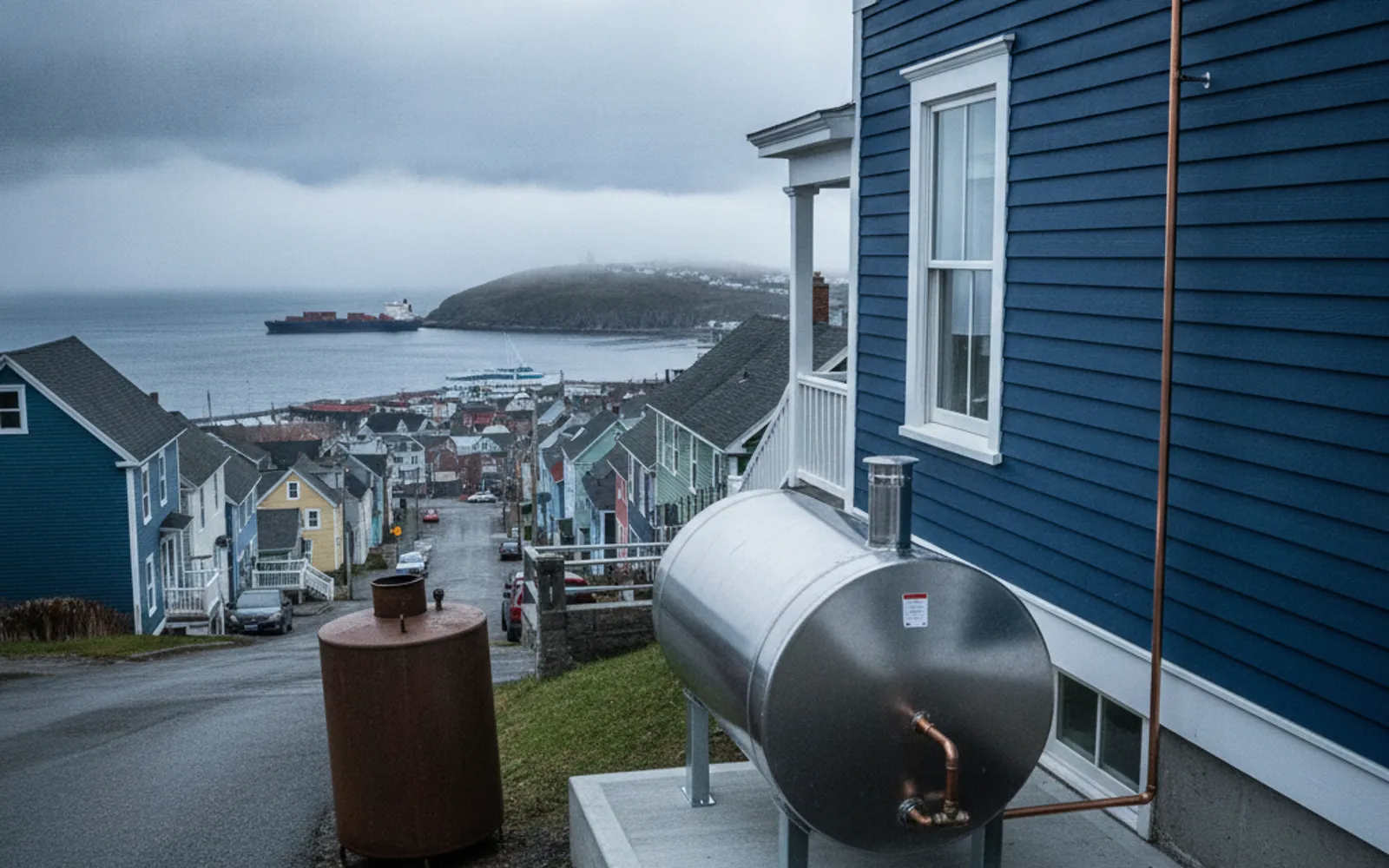
Expired tag, rusted legs, or a driver who wouldn't fill you? We swap out old heating oil tanks across the Northeast Avalon, usually within the week, for $3,200 installed.
Harbour Tank Co handles oil tank replacement in St. John's and the surrounding Avalon communities. We pull the old tank, set the new one, connect it to your furnace, and have a licensed inspector tag and register it so your fuel company can deliver again. The price is $3,200 for a 200-gallon steel tank or $3,850 for fibreglass, and both include removal of the old tank.
Most calls we get start the same way: the delivery truck showed up, the driver checked the HOST tag, saw an expired date, and left without filling. That's a bad afternoon in January. Call (709) 800-3117 and we'll get you a written estimate and a swap date, or read on to see how the process works and what drives the cost.
Once you approve the estimate we book you in for the same week. If you're out of oil or your tag has already expired, tell us and we'll move you up.
Disconnecting, draining and hauling away the old tank is part of the $3,200 price. No surprise line item for disposal.
A 200-gallon steel tank is $3,200 installed. A fibreglass tank is $3,850 and doesn't carry a set expiry date under NLR 60/03, which matters if you plan to stay in the house a while.
A licensed inspector tags and registers the new system with Digital Government and Service NL and issues the confirmation of registration your insurer and lawyer will ask for.
We look at the tank, the lines and the site, then put the number in writing before any work starts. No obligation and no pressure.
Refused delivery, a wet spot under the tank, or the smell of oil in the basement? Call (709) 800-3117 any hour and you'll reach a person, not a machine.
Every registered oil tank in Newfoundland and Labrador carries a small metal HOST tag near the fill or the outlet. Stamped on it is an expiry in MM-YYYY form. If that month has passed, the tank is expired in the eyes of the province and of your fuel supplier, no matter how solid it looks.
The expiry comes from the Heating Oil Storage Tank System Regulations, NLR 60/03. Section 15 sets a life of 10 to 25 years for mild-steel tanks depending on where it sits, how thick the steel is, and where the outlet is. An outdoor single-wall 14-gauge tank with an end outlet, which is the most common setup on older St. John's homes, gets 10 years. Indoor tanks, thicker steel and bottom outlets earn longer terms.
Beyond the tag, watch for these signs:
Any of those on their own is worth a call. A tank that's both expired and showing rust is a same-day conversation, especially in winter.
We keep pricing simple. A 200-gallon steel tank, installed, with the old tank removed and hauled away, is $3,200. A fibreglass tank of the same size is $3,850, again with removal included. Both prices are in Canadian dollars and cover the tank, stand, fittings, fill and vent piping, connection to your furnace line, and the inspector's tagging and registration visit.
The difference between the two comes down to lifespan. Steel goes back on the 10 to 25 year clock under NLR 60/03 the day it's installed. Fibreglass isn't subject to that same expiry table, so it's the tank we suggest for anyone planning to stay put or thinking about resale. Read more on our fibreglass upgrade page.
Extras that can change the number are rare but real: a tank that has to be cut up to get out of a tight basement, a new concrete pad because the old one has heaved, or a long run of new copper line. We'll flag any of those in the written estimate, not after the truck shows up. For a fuller breakdown see our cost guide.
Here's the day, start to finish, so you know what to expect.
Most swaps are done in a single visit. Once the new HOST tag is on, call your fuel company and book a delivery. The driver will see a current date and fill you without a fuss.
We're based in St. John's and work across the Northeast Avalon and out into Conception Bay South and Conception Bay North. That includes Mount Pearl, Paradise, Conception Bay South, Torbay, Portugal Cove-St. Philip's and Bay Roberts.
Older neighbourhoods in the city centre, the Goulds, Kilbride and Shea Heights tend to have the most 10-year outdoor steel tanks coming due, but we see plenty of expired tags in newer subdivisions too. If your community isn't listed, call anyway. If it's on the Avalon, we can likely get to you.
Not sure whether your tank is due? Send a photo of the HOST tag to info@harbourtank.ca or call (709) 800-3117 and we'll read the date for you.
Under NLR 60/03 section 15, a mild-steel tank is allowed 10 to 25 years depending on gauge, outlet position and whether it's indoors or out. The most common tank on an older St. John's home, an outdoor single-wall 14-gauge tank with an end outlet, gets 10 years. The exact expiry for your tank is stamped on the HOST tag as MM-YYYY.
Section 13 of the regulations says a supplier can't legally deliver to an unregistered or expired tank, so the driver had no choice. Call us at (709) 800-3117 and we'll book a swap, usually within the week, and faster if you're out of oil. A new 200-gallon steel tank is $3,200 installed and once the inspector tags it you can rebook your delivery. Our expired tank emergency page walks through the steps.
Steel is $3,200 installed and goes back on the 10 to 25 year expiry clock. Fibreglass is $3,850, won't rust, and isn't tied to the same steel expiry table under NLR 60/03. If you plan to stay in the house more than 10 years or want a clean answer for a buyer's lawyer, the extra $650 for fibreglass usually pays for itself.
Most swaps are finished in one visit of about four to six hours, including draining the old tank, setting the new one, and firing the furnace. Booking is typically same-week from the day you approve the written estimate. The inspector's tagging and registration visit is coordinated so you're not waiting on paperwork to get oil.
Yes. The licensed inspector who tags the new tank registers it with the province and issues a confirmation of registration. Insurers ask for it at renewal and real estate lawyers ask for it before closing. Keep a copy with your house papers and take a photo of the HOST tag so the expiry date is easy to find later.
Free written estimates. Emergency calls answered around the clock.