
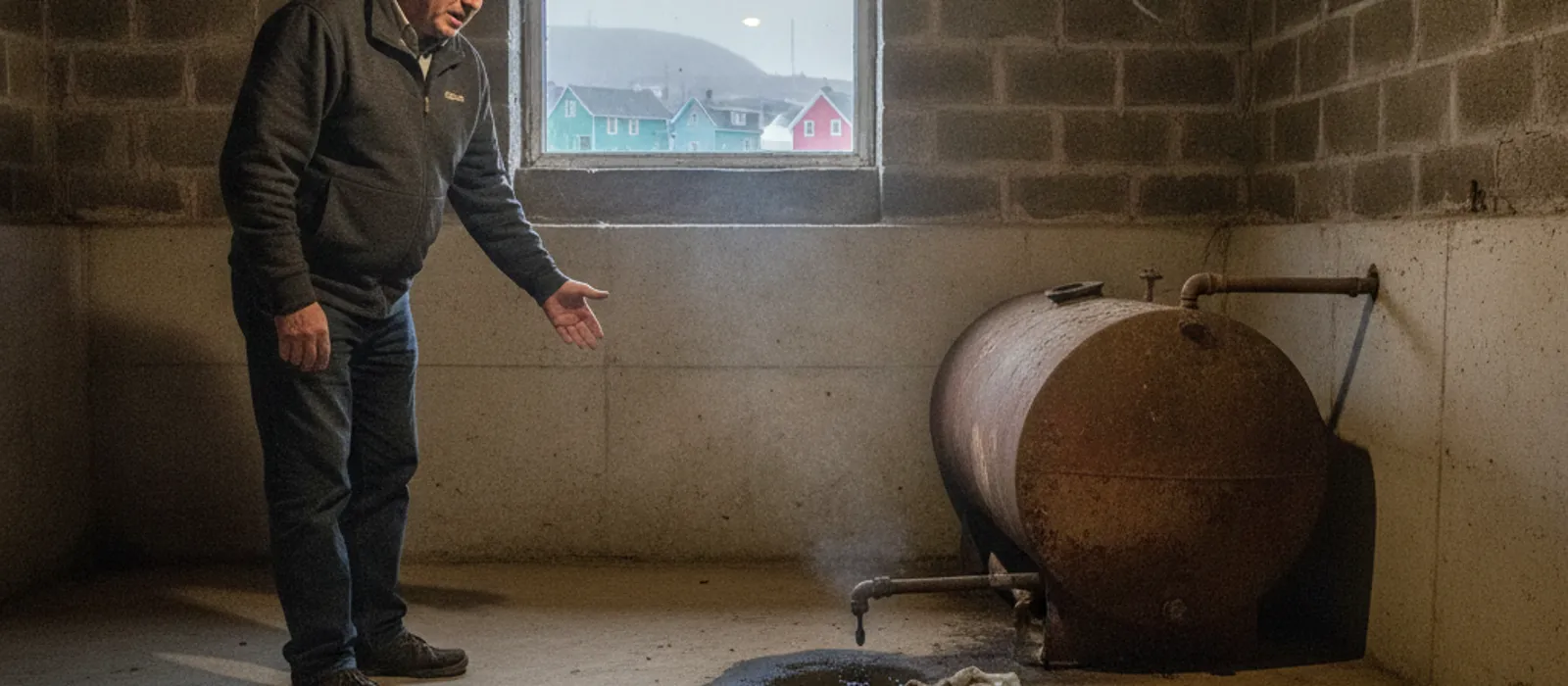
You head down the basement stairs with a load of laundry and it hits you: that heavy, diesel-like smell that wasn’t there yesterday. Your first thought is the tank. Your second thought is the cost.
Take a breath. Search “oil smell in basement” and you’ll find plenty of panic and not much practical advice, so here’s the honest version. Across St. John’s and the Avalon this is one of the most common calls we get, and most of the time the cause is small and fixable. A weeping filter, a bit of oil on the fill cap after a delivery, a fitting that needs a quarter turn.
Sometimes it’s a tank at the end of its life, and that’s a different conversation. This guide covers what the smell usually means, what you can safely check in about ten minutes, and the exact signs that mean stop and pick up the phone.
First, Is the Oil Smell in Your Basement an Emergency?
Most oil smells aren’t emergencies. Furnace oil doesn’t flash the way gasoline does, and a faint smell near the tank for a day after a fill-up is normal. But there are four situations where you should skip the checklist and call right away.
Call now if you see any of these:
- Oil pooling on the floor, even a puddle the size of a dinner plate, or a steady drip you can watch.
- A wet or shiny patch on the tank bottom or a seam that comes back after you wipe it.
- A smell strong enough to give you a headache, or you feel dizzy or sick to your stomach down there.
- The gauge dropped overnight and the furnace hasn’t been running hard enough to explain it.
If any of those match, shut the furnace off at the emergency switch (usually a red switch at the top of the basement stairs), open a window if you can, and keep kids and pets upstairs. Don’t run a fan across the spill. Don’t try to move the tank, drain it, or patch a pinhole with putty or tape. A tank that’s weeping today can let go tomorrow.
Then call our 24/7 emergency line at (709) 800-3117. A leaking tank on the Avalon is a same-day problem, not a next-week one, and our installers handle the tank, the oil, and the paperwork that follows. Our guide on what to do when an oil tank is leaking covers the first hour in detail.
One more thing worth knowing. Under Newfoundland and Labrador’s Heating Oil Storage Tank System Regulations, a tank that has leaked must be emptied and removed within 10 days, with 30 days to finish the cleanup. That clock is why we say call the moment you confirm a leak, not after a week of thinking about it.
The 7 Most Common Causes of an Oil Smell in the Basement
If nothing above applies, good. Now let’s figure out what you’re actually smelling. In a St. John’s basement, the cause is almost always one of these seven.
1. A weeping oil filter or fitting
This is the number one cause. The filter canister sits on the oil line between the tank and the furnace, and its gasket dries out over the years. The flare fittings on either side loosen a hair with every heating season. The result is a slow weep that never makes a puddle but keeps the concrete underneath damp and smelly.
The gauge on top of the tank does the same thing. Its dome seal cracks with age, and you get a faint smell and a greasy ring around the base.
2. A leaking oil line
Older homes around the Northeast Avalon often have a bare copper oil line running along or under the basement floor. Concrete and copper don’t get along, and the line pits where it touches the slab or passes through the foundation. A line leak smells stronger than a filter weep and often shows up as a dark stain along the line’s path.
3. The tank itself
Steel tanks rust from the inside out. Water condenses inside, sinks to the bottom, and sits under the oil, and that’s where the pinholes start. The first sign is usually a “sweating” tank: a damp patch or a bead of oil on the bottom seam or around the outlet fitting.
Picture a homeowner in Mount Pearl, we’ll call her Denise, who smelled oil every time she went down to the laundry. The paper towel came up clean at the filter but oily along the tank’s bottom seam. The tag on her indoor tank was stamped 11-2026, so it was months from expiring anyway. She had it replaced with a 200-gallon painted steel tank for $3,200 installed, with the old tank removed and disposed of as part of that price.
4. Overfill or a bad vent whistle
Every tank has a vent pipe with a whistle inside. The whistle sounds while the tank fills and goes quiet when it’s full, which is how the driver knows to shut off. If the whistle is plugged or the vent is blocked, the tank can be overfilled and oil pushed out the vent or the fill. It runs down the foundation, finds a crack or a basement window, and you smell it inside.
Take a fellow in Kelligrews, call him Gerry, who noticed the smell the afternoon of a delivery and figured it would fade. It didn’t. Outside there was a streak of oil down the foundation under the vent pipe, and a whistle that never sounded. The tank had rust bloom across the bottom and was well past the limit for a single-wall outside tank, so he went with a fibreglass tank at $3,850 installed, which doesn’t rust in the salt air off Conception Bay.
5. Delivery residue
After a fill-up, a bit of oil on the fill cap, a drip from the hose, or a splash under the fill pipe is normal. It smells for a day or two and then fades. If the smell started the day of a delivery and gets weaker every day, this is probably your answer.
6. The furnace
Not every oil smell is raw oil. If it’s more like exhaust or soot, the furnace is the suspect. Delayed ignition, a dripping nozzle after shutdown, a blocked chimney, or a stuck barometric damper can all push combustion smell into the basement. That’s a heating technician’s job, not a tank job, and black puff marks around the furnace make it a call-today problem.
7. An old spill in the floor
Concrete soaks up oil like a sponge. If a previous tank ever leaked, that oil is still in the slab or the dirt floor. It goes quiet in winter and comes back in a humid August or when the furnace warms the floor. This one fools people because there’s no drip to find.
What to Check First: A 10-Minute Walk-Through
Grab a flashlight, a roll of paper towel, and your phone for photos. Do this in order, and stop the moment you find active oil.
Step 1: Use your nose. Raw heating oil smells oily and heavy, like diesel at a fuel pump. Burnt oil smells like exhaust or a snuffed candle. Raw oil points at the tank, the line, or the filter. Burnt oil points at the furnace.
Step 2: Look under the tank. Get down low and shine the light along the bottom seam, the outlet fitting, and the legs. Look for a wet sheen, a bead of oil, or a dark patch on the floor. Wipe the seam with a paper towel. If it comes up oily, the tank is weeping, so stop here and call.
Step 3: Check the filter and fittings. Wipe the filter canister, its bottom bolt, and the flare nuts on both sides. A damp towel with no drip usually means a gasket or a fitting that needs snugging. That’s a small job for a technician, and it’s the fix in most basements.
Step 4: Follow the line. Trace the copper line from the tank to the furnace. Look for green or white crust on the copper, dark stains where it meets the floor, and any spot where it disappears into concrete.
Step 5: Read the gauge and the tag. Note the gauge level and check it again tomorrow at the same time. Then find the metal HOST tag on the tank. It carries a six-digit number and an expiry stamped in month-year form, so “7-2028” means the tank can’t be used after July 31, 2028. Our guide on how to read a HOST tag walks through it.
Step 6: Go outside. Check the ground under the fill and vent pipes and the foundation wall below them. Oil on the siding or a stain down the concrete means an overfill or vent problem, not a basement leak.
Step 7: Check around the furnace. A soot smudge above the burner door or a black puff pattern on the floor means a furnace problem. Turn it off and call a heating tech.
Write down what you found and take photos. When you call for an estimate, those photos let the installer tell you over the phone whether you’re looking at a fitting, a line, or a tank.
Not sure what you’re seeing? Send us a couple of photos and we’ll give you a free written estimate, no charge and no pressure.
Basement Oil Smell Sources Compared
Here’s the whole list side by side, so you can match what you found to the likely cause.
| Source | How it smells | What you’ll see | Who fixes it |
|---|---|---|---|
| Filter or fitting weep | Faint, steady, near the furnace | Damp ring under the filter, oily towel | Heating tech, small job |
| Gauge dome seal | Faint, near the top of the tank | Greasy ring around the gauge | Heating tech, small job |
| Oil line leak | Moderate to strong along the line | Dark stain, green crust on copper | Installer replaces the line |
| Tank sweating or pinhole | Strong, worst right at the tank | Bead of oil on seam or bottom, wet floor | Installer, tank replacement, call now |
| Overfill or blocked vent | Strong right after a delivery | Oil on siding, stain down the foundation | Installer checks the vent; talk to your delivery company about their spill |
| Delivery residue | Strong on day one, gone in two or three | Oil on the fill cap, small spot under the fill | Nobody, it fades |
| Furnace combustion | Exhaust, soot, smoky | Soot above the burner door, puff marks | Heating tech |
| Old spill in the slab | Comes and goes with humidity | Dark patch, no drip | Environmental cleanup, quoted case by case |
One more source that isn’t on most lists: an outside tank that’s disconnected but still standing. A homeowner in Torbay, call him Wade, switched to a heat pump two winters ago and left the empty tank where it stood. The smell in his basement came from the old oil line, still full, still connected through the foundation, and seeping at a pitted spot inside. The regulations say a disconnected tank should be emptied and removed within 30 days anyway.
Removal and disposal of the outside tank was $500, with the line capping and the small cleanup inside quoted separately. Cheaper than the two years he spent blaming the floor drain.
What It Costs to Fix the Cause
The good news is that the most common causes are also the cheapest. A gasket or a fitting is a short service call from a heating technician. A line replacement is a bigger job but still well short of a new tank.
When it is the tank, here’s what you’re looking at on the Avalon. Every replacement price below includes removal and disposal of the old tank, and the installer’s licensed inspector tags and registers the new system so your delivery company will fill it.
| Job | Price (CAD) |
|---|---|
| 200-gallon painted steel tank, installed, inside or outside | $3,200 |
| Fibreglass tank, installed, inside or outside | $3,850 |
| Roth double-wall tank, installed inside | $3,850 |
| 100-gallon steel tank for a heat-pump backup home | $3,100 |
| Outside tank removal and disposal only | $500 |
| Basement tank removal only | Quoted case by case |
| Emergency or after-hours call-out | Varies by contractor |
Fibreglass and Roth tanks don’t rust, which matters in a damp basement or anywhere the salt air reaches. Steel is the lower price and still the standard choice for most homes. Inside tanks also get a longer life on the tag: a 14-gauge end-outlet steel tank is allowed 15 years inside, and a 12-gauge bottom-outlet tank up to 25.
Our oil tank replacement cost guide has the full breakdown, and the St. John’s replacement page explains what happens on the day.
When to Stop Looking and Call a Professional
You’ve done the walk-through. Here’s the line between “keep an eye on it” and “make the call.”
Keep an eye on it if the smell started with a delivery, the towel came up clean, and it’s fading. Check the gauge each morning for a few days. If it holds steady and the smell is gone by day three, you’re fine.
Make the call if:
- The towel came up oily at the tank seam, the bottom, or the outlet. That’s a tank job, and it’s the 24/7 line.
- The line is stained, crusted, or wet anywhere along its run.
- The smell is still there three days after a delivery and you can’t find a source.
- The HOST tag is expired or expires within the year. A driver can’t fill a tank without a valid tag and has to report any leak they spot, so our expired tank emergency page explains what to do if you’ve already been refused.
- You see soot or puff marks around the furnace.
- You’re simply not sure. A free written estimate costs nothing, and a wrong guess in January costs plenty.
One thing not to do: don’t hose oil down the floor drain or out the door. If oil has reached soil, a drain, or water, it has to be reported to the province’s 24-hour environmental emergencies line. The province’s Petroleum Storage and Management page has the details, and our guide on reporting an oil spill in Newfoundland walks you through the call.
Ready to get it sorted? Call (709) 800-3117 or request a free written estimate. We serve St. John’s, Mount Pearl, Paradise, Conception Bay South, Torbay, Portugal Cove-St. Philip’s, and out to Bay Roberts, licensed and insured.
Frequently Asked Questions
Is an oil smell in the basement dangerous?
Usually it’s a nuisance more than a danger, because furnace oil doesn’t ignite easily at room temperature. The fumes can still cause headaches, nausea, and dizziness, so ventilate the space and limit your time down there until you find the source. If the smell makes you feel unwell or you see oil pooling, treat it as an emergency and call right away.
Why does my basement smell like oil after a delivery?
A little oil on the fill cap, a drip from the hose, or a splash under the fill pipe is normal after a fill-up and fades within a day or two. If the smell is strong and you find oil running down the foundation under the vent, the tank may have been overfilled because the whistle didn’t sound. That’s worth a call to your delivery company and to an installer who can check the vent.
Will my oil company still deliver if there’s a smell or a small leak?
Not if the driver sees a leak or an expired tag. Under Newfoundland and Labrador’s regulations, drivers can’t deliver to a tank without a valid registration label, and they have to report any deficiency they notice to the owner and the province. A refused delivery in winter is exactly the panic we help with, so call before it gets to that point.
How do I get rid of the oil smell once the leak is fixed?
Wipe up fresh oil with absorbent pads or cat litter, bag it, and ventilate the basement with a window open and a fan pulling air out, not blowing across the spot. A small stain on sealed concrete fades over a few weeks. Oil that has soaked into bare concrete or a dirt floor keeps smelling every humid stretch and needs professional cleanup, which is quoted case by case.