
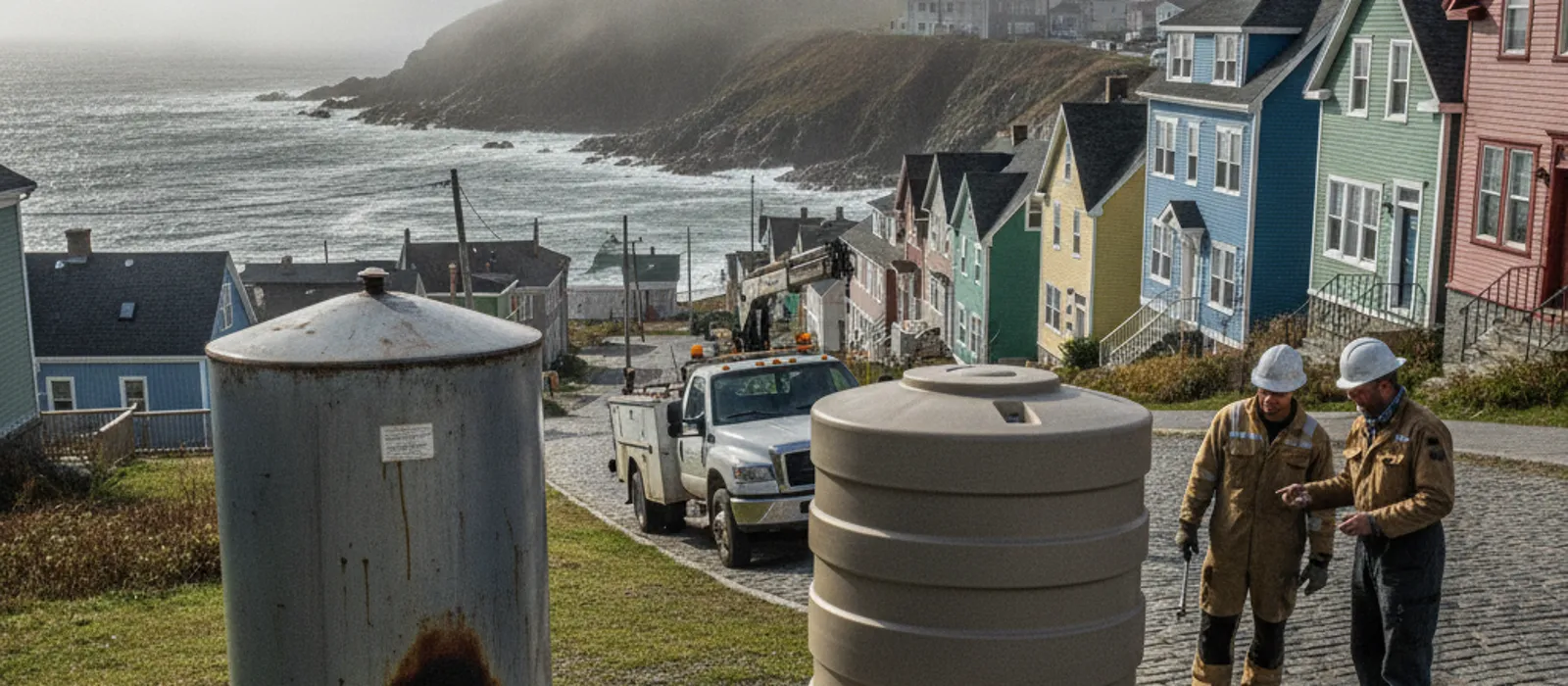
It’s ten past six on a February morning in St. John’s, the furnace has run all night, and there’s a smell in the basement you can’t place. You walk over to the tank and see a dark wet line down one seam and a slick on the concrete. Your stomach drops.
If you’ve just typed “oil tank leaking what to do” into your phone, take a breath. Most residential leaks on the Avalon are slow drips, not gushers, and the next sixty minutes are about keeping a small mess small. This guide walks you through it in the order that matters: stop the flow, keep people safe, make two phone calls, and get the tank dealt with before it turns into a cleanup bill that dwarfs the price of a new one.
First Ten Minutes: What to Do When Your Oil Tank Is Leaking
Do these in order. None of them needs tools you don’t already have.
1. Close the valve at the tank. Every tank has a shut-off valve where the oil line leaves it, usually right at the outlet, often with the filter bowl hanging off it. Turn it clockwise until it stops. If the leak is below the valve (at the filter, the fittings or the line itself), this stops the flow. If the leak is in the tank shell, it won’t, but close it anyway so the furnace can’t draw more oil through a damaged line.
2. Shut off the furnace. There’s a red emergency switch, usually at the top of the basement stairs or on the wall near the burner. Flip it. You don’t want the burner firing with fuel dripping nearby, and you don’t want the pump pulling air through a bad line.
3. Get something under the drip. A basin, a bucket, a roasting pan, a cut-open jug, whatever’s close. A drip that fills a coffee cup an hour will fill a bucket by supper. Catching it beats scrubbing it out of concrete.
4. Open a window or a door. Furnace oil doesn’t flash like gasoline, but the fumes will give you a headache fast and they linger in a closed basement for days. Get air moving. Keep kids and pets upstairs.
5. No flames, no sparks. No smoking, no lighting the woodstove, no running the dryer or a space heater in that room. Furnace oil is hard to ignite at room temperature, but you’re not going to test that today.
If the drip keeps coming with the valve closed, the tank shell has failed and there’s no homeowner fix for that. Call us at (709) 800-3117. It’s a 24/7 line and a leaking tank is exactly what it’s for. We’ll talk you through the next steps while you wait and get someone out to look, with a free written estimate and no pressure.
Now find the source. Wipe the wet area dry with a paper towel and watch where the first bead comes back. There are four usual suspects.
A drip at the filter or a fitting. The filter canister, the valve stem, or a compression fitting on the copper line. This is the most common leak on outdoor tanks in Conception Bay South and Bay Roberts after a freeze-thaw week, because ice and wind work the joints loose. It’s also the least serious. If the valve is closed and the drip has stopped, you’ve bought yourself time.
A weep at the bottom seam or a pinhole in the shell. Steel tanks rust from the inside out. Water settles under the oil and eats the bottom for years before anything shows. Closing the valve does nothing for this one. The tank is finished.
Oil on the ground under an outdoor tank with no visible drip. Check the legs and the pad. If the tank has shifted or a leg has sunk, a fitting may have cracked out of sight. Don’t push or shove the tank to look. A full 200-gallon tank weighs the better part of a tonne.
A wet oil line where it enters the house. Copper lines corrode where they touch concrete. If the oil is along the line and not at the tank, the tank may be fine and the line needs replacing.
Here’s the honest rule for DIY: you can close a valve, catch a drip, open a window, and snug a loose compression nut a quarter turn if you’re handy with a wrench. That’s where homeowner work ends. Draining the tank, patching steel, moving the tank or opening the line is a job for a contractor. Epoxy on a rusted seam is a Tuesday fix that comes back Thursday, and a seam letting go while you’re crouched under it is a real injury risk.
Two Phone Calls: Who to Call About a Leaking Oil Tank, and in What Order
Once the flow is stopped or contained, make two calls. Neither one is optional and the order matters.
Call one: the NL Spill Report Line, 1-800-563-9089. It’s a 24-hour line and it’s the number the province lists in its own guidance for homeowners with damaged oil tanks. Yes, even for a drip you caught in a bucket. A heating oil release is reportable in this province, and reporting it isn’t an admission of anything. It puts you on record as having done the right thing, which your insurer and any future buyer of the house will care about. Have your address handy, roughly how much leaked, and whether it reached soil or a drain. We cover the whole process in how to report an oil spill in Newfoundland.
Call two: a tank contractor. That’s us, or whoever you trust. You need someone who can pump the remaining oil out of a leaking tank, remove it, and put a new one in fast enough that you’re not without heat. Ask what the emergency premium is before they roll. It varies by contractor and you should know the number up front.
A third call, the same day if you can: your insurance broker. Don’t assume you’re covered and don’t assume you’re not. Home policies treat oil escapes very differently, and what every policy shares is a duty to report promptly. We wrote up what to expect in does insurance cover oil tank leaks.
One call you probably don’t need to make: your oil delivery company. Under section 13 of the province’s heating oil tank regulations, a driver can’t fill a tank without a valid registration label, and they have to report any deficiency they spot to you and to the department. They won’t top up a leaking tank and they’re not the ones who fix it.
Three Mornings on the Avalon
These three homeowners are composites, not customers, but the prices are our real prices and the situations are the ones we see most.
Marie, Torbay. Indoor 200-gallon steel tank, 14 gauge, bottom outlet. HOST tag stamped 3-2027, so still legal, but there’s a damp rust ring at the bottom seam and a smell that’s been growing for a week. She closes the valve, puts a turkey pan under the drip, opens the basement window and calls the spill line at 6:20 a.m. A shell leak means the tank is done, no matter what the tag says. She goes with a fibreglass tank installed inside, $3,850 including removal of the old one, and gets a tag that’ll outlast her mortgage. Because she caught it at a pan’s worth, there’s no floor remediation to pay for.
Gerald, Kelligrews, Conception Bay South. Outdoor tank on the side of the house facing the bay. The delivery driver finds it: a slow weep at the filter bowl after a week of freeze and thaw, with a dinner-plate stain in the snow. The driver refuses the fill, tells Gerald, and reports it. Gerald closes the valve and the drip stops, so the shell is likely fine. But the tag reads 11-2025, already past its date, so the driver couldn’t have filled it anyway. He replaces it with a 200-gallon painted steel tank, $3,200 installed, old tank hauled away, and has a delivery booked for Thursday.
Wanda, Mount Pearl. Outdoor tank, pinhole in the bottom, oil in the gravel underneath. Wanda put in a heat pump last year and has been meaning to deal with the tank. She reports the spill, has the remaining oil pumped out, and pays $500 to have the outdoor tank removed and disposed of. The contaminated gravel is a separate conversation with a remediation company, and it’s the part that could’ve been avoided if the tank had come out last fall. Under section 18 of the regulations a leaking tank has to be emptied and removed within 10 days, so waiting isn’t an option anyway.
What a Leaking Tank Costs to Replace in St. John’s
Here’s what the tank side of the bill looks like. Every installed price includes removal and disposal of the old tank.
| Option | Where | Installed price (CAD) | Tag life |
|---|---|---|---|
| 200-gallon painted steel tank | Inside or outside | $3,200 | 10 to 25 years, set by gauge, outlet and location under s.15 |
| Fibreglass tank | Inside or outside | $3,850 | Set by the administrator, up to 50 years; tags seen stamped to 2061 |
| Roth double-containment tank | Inside | $3,850 | Set by the administrator, up to 50 years |
| 100-gallon painted steel tank (heat pump backup) | Inside or outside | $3,100 | Same steel rules as above |
| Removal and disposal only, outdoor tank | Outside | $500 | n/a |
| Removal only, indoor or basement tank | Inside | Quoted case by case | n/a |
What the table doesn’t include is cleanup. Oil that reaches soil, a sump, a drain or a neighbour’s property is a remediation job, and remediation is priced by how much contaminated soil and material has to be dug out and hauled away, not by the tank. That’s the number that gets scary, and it’s the whole reason the first hour matters. We break down what drives it in oil spill cleanup cost.
The steel life figures come straight from section 15 of NLR 60/03, the Heating Oil Storage Tank System Regulations. Outside, single wall, top outlet, 14 gauge is 10 years. Inside with a bottom outlet in 12 gauge is 25. Fibreglass and double-wall tanks get a life set by the administrator, capped at 50 years. The installer’s licensed inspector tags and registers whatever goes in, and you get the paperwork. For the full breakdown of what’s in a quote, see oil tank replacement cost.
If you want a number for your own house before you decide anything, send us the tag number and a photo and we’ll put a written estimate together. No charge, no obligation.
What Happens After the First Hour
Once you’ve stopped the flow, reported it and got a contractor lined up, here’s how the next few days usually go.
The rest of today. The contractor pumps the remaining oil out of the leaking tank into drums or straight into a new tank. If you’ve got a shell leak, the old tank comes out the same visit where it’s practical. An outdoor tank in December with a foot of snow around it may take a day. Keep the valve closed and the basement ventilated until then.
Within 10 days. Section 18(5) of the regulations gives you 10 days after a leak to empty the tank, remove sludge and oil, dismantle it, and cap or remove the piping. The contractor does the work, but the clock is on you as the owner. You then have 30 days for remediation of anything the oil touched.
Heat in the meantime. If the tank comes out before the new one goes in, you may be on electric heaters for a night or two. Have a couple ready. If someone in the house is elderly or on oxygen, say so when you call so the contractor can prioritize you.
The new tank and the tag. A new tank goes in on a proper stand and pad, the line is replaced if it’s suspect, and the licensed inspector registers it and hangs the tag. Take a photo of the tag. Your insurer, your oil company and any future buyer will ask for it. With a valid tag, you’re back on the delivery schedule.
If your tank isn’t leaking but the tag has expired and the truck has driven past, that’s a different kind of emergency with the same answer. Our expired oil tank emergency page covers it. If you’d rather get ahead of this whole thing, oil tank replacement in St. John’s explains what a planned swap looks like when nobody’s standing in a puddle. Just need the old one gone? See oil tank removal.
What Not to Do With a Leaking Oil Tank
A few things we’ve seen that make a bad morning worse.
Don’t hose it down. Water spreads oil and pushes it into soil and drains. Absorb, don’t rinse. Kitty litter, sawdust, or the absorbent pads from the hardware store all work on concrete.
Don’t pour it down a drain, a sump or the storm sewer. That turns a reportable drip into a much bigger reportable problem. Bag the used absorbent and set it aside. The contractor can tell you where it goes.
Don’t patch the tank and keep using it. A tank with a shell leak has failed. The regulations say it has to come out within 10 days, and the province’s own guidance says to replace a leaking tank even if it’s been temporarily sealed.
Don’t try to move or tip the tank. Especially not a full one, and especially not alone.
Don’t wait a week to report it. Reporting is fast, free and protects you. Waiting is the thing insurers and buyers hold against people.
Don’t assume the oil in the tank is lost money. A contractor can often pump out what’s clean and put it in the new tank. Ask.
If you’re in the middle of this right now, call (709) 800-3117, day or night. We’ll walk you through the valve and the spill line if you haven’t done them yet, and get a real person and a written estimate to your door.
Frequently Asked Questions
Do I really have to report a small oil tank leak in Newfoundland?
Yes. The province lists the Spill Report Line, 1-800-563-9089, as a step for any homeowner with a leaking tank, and a heating oil release is reportable regardless of size. The call takes a few minutes and puts you on record as having handled it properly. Your insurer will expect to see that you did.
Can I keep using my tank if the leak is only at the filter?
If closing the valve stops the drip entirely, the tank shell is probably sound and a tech may only need to replace the filter, gasket or fitting. Don’t reopen the valve yourself until it’s been fixed and checked. If the tank’s HOST tag is expired, or close to it, you’ll likely be told to replace the tank rather than repair a fitting on a tank that’s nearly out of time.
How fast can a leaking oil tank be replaced in St. John’s?
In most of the Northeast Avalon a straightforward outdoor swap can happen within a day or two of the call, and an emergency call can often get the old tank pumped out the same day. Indoor tanks, deep snow and tight access add time. Ask about the emergency premium up front, because it varies by contractor.
Will my insurance pay for the tank and the cleanup?
It depends entirely on your policy. Some home policies cover oil escape and cleanup, some cap it, and some exclude it outright, and a tank past its tag date can affect coverage that would otherwise apply. Call your broker the same day, report the leak, and keep every receipt and photo. Don’t wait to hear back before you stop the leak and get the tank dealt with.