
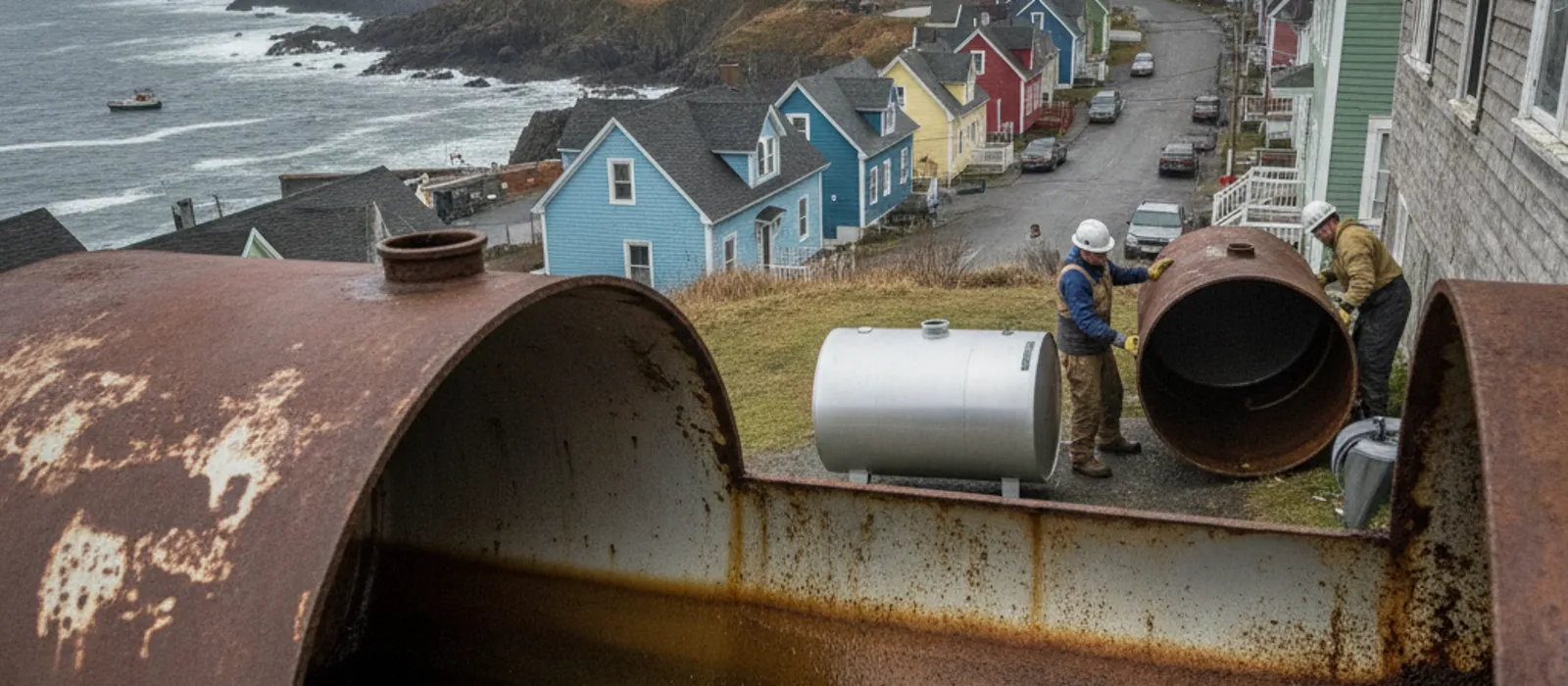
Your furnace kicks on, runs for a minute, coughs, and dies. You hit the reset button, it fires again, and then it quits. It’s minus 12 outside, the wind’s coming straight off the harbour, and the gauge says you’ve got half a tank. So what’s going on?
Nine times out of ten when we hear that story around St. John’s, the answer is water in the oil tank. Not much of it, either. A cup or two sitting on the bottom of a 200-gallon tank is enough to shut a furnace down, freeze a line, or eat a hole through steel from the inside out. The good news is that water is one of the easier tank problems to catch, and if you catch it early, one of the cheaper ones to fix.
This guide walks through how water gets into a heating oil tank in the first place, how to check for it in about ten minutes, how it gets pumped out, and how to tell when the water has already done enough damage that the tank needs to go.
Why Water in an Oil Tank Matters More Here Than Most Places
Heating oil floats on water. So any water that gets into your tank sinks straight to the bottom and stays there. That’s the problem. The bottom of the tank is where the steel is thinnest after years of service, where sludge collects, and on a bottom-outlet tank, where the fuel line draws from.
Three things happen once water settles in:
- Rust from the inside. Water sitting against bare steel corrodes it. Most tanks that fail on the Avalon don’t rust through from the outside where you can see it. They rust through from the inside, at the bottom seam, where nobody looks. By the time you see a weep on the outside, the steel’s already gone.
- Sludge and bacteria. Microbes live in the layer where oil meets water. They feed on the fuel and leave behind a black, slimy sludge that clogs filters and nozzles. If you’ve ever had a furnace tech pull a filter that looked like tar, that’s where it came from. We’ve got a full post on sludge in oil tanks if you want the details.
- Frozen lines. This is the St. John’s special. Water drawn into the fuel line freezes at zero degrees, long before the oil itself thickens. A slug of ice in a quarter-inch copper line stops the furnace dead. It’s one of the most common reasons a furnace stops getting oil in January.
There’s a paperwork side too. Under the province’s Heating Oil Storage Tank System Regulations, a tank taken out of service after a leak or water intrusion has to be emptied, cleaned out and removed within 10 days instead of the usual 30. Delivery drivers are required to report deficiencies they spot, and nobody wants to learn about a tank problem from a note on the fill ticket in the middle of January.
If you’ve already got a furnace that won’t stay lit and you suspect water, don’t keep hitting the reset button. Each reset floods the combustion chamber with unburned oil. Call us at (709) 800-3117 and we’ll help you sort out whether it’s a tank problem or a furnace problem before you spend money on the wrong fix.
How Water Gets Into a Heating Oil Tank
Water finds its way into oil tanks by four main routes. Most tanks with a water problem have more than one going at once.
Condensation
This is the big one, and it happens to sound tanks with tight caps. Every tank has air space above the oil, and warm, damp air fills that space during the day. It cools at night and drops its moisture on the inside walls, where the droplets run down and collect on the bottom. A half-empty outdoor tank through a foggy Avalon summer can pick up a surprising amount of water this way, a bit at a time, all season long.
The less oil in the tank, the more air, and the more condensation. That’s the whole reason we tell people to keep the tank full through the summer. It’s not about the price of oil. It’s about the air.
Rain and snowmelt through the fill and vent
Outdoor tanks have two openings: the fill pipe and the vent. Both should have caps. The fill cap gets left loose after a delivery, or the gasket dries out and cracks. The vent cap rusts, or a storm knocks it sideways.
Once that happens, every rain squall that blows through puts a little water straight into the tank. Drifting snow that piles against an open vent does the same thing when it melts.
Leaking seams and fittings
Water can get in through the same places oil gets out. A hairline crack at a weld seam, a fitting that’s backed off a turn, a gauge that no longer seals. On a tank that’s tilted the wrong way, rainwater can pool on top and sit against those fittings for days.
Delivered with the oil
It’s rare, but not impossible. Water can ride along in a delivery if the supplier’s own storage has condensation trouble. If you find water in a tank that was bone dry a week ago and nothing else has changed, it’s worth a polite call to your oil company.
Signs and a 10-Minute Test for Water in Your Oil Tank
You usually don’t see water in an oil tank. You see what it does.
Signs worth acting on:
- The furnace runs, cuts out, and needs resetting, especially in cold snaps
- The burner sputters, or the flame looks lazy and orange instead of clean
- The oil filter clogs long before its normal change interval
- Rust flakes or black sludge in the filter bowl
- Frost or ice on the fuel line at the tank outlet in winter
- A delivery driver mentions the tank “took a lot” or notes a deficiency on the ticket
- Bubbling paint or a damp patch along the tank’s bottom seam
The test. If your tank is easy to reach and you’re comfortable around it, you can check for water yourself with water-finding paste. It’s a small tube sold at marine supply and hardware stores around St. John’s, and it’s the same stuff fuel depots and boat owners use.
- Take a clean wooden dowel or a length of stiff rod long enough to reach the bottom of the tank.
- Smear a thin coat of paste on the bottom two or three inches.
- Open the fill cap, lower the rod straight down until it touches bottom, hold it there for ten seconds, and pull it up.
- Look at the paste. It changes colour (usually to red or purple) exactly where it touched water. The height of the colour change is the depth of water in your tank.
Anything under a quarter inch on a big tank is normal condensation and worth watching. Half an inch or more is a problem that needs dealing with before the cold sets in. If the paste comes up coated in black sludge as well, you’ve got both problems, and the water has probably been in there a while.
When to stop and call. Don’t do this test on a tank that’s leaking, badly rusted on the bottom, or wobbly on its stand. Don’t do it if the tag has expired, because the tank can’t legally take oil anyway and it’s headed for removal regardless. And if you smell oil or see a sheen on the ground, skip the test and call, because a leaking tank is an environmental problem, not a maintenance one.
How to Get Water Out of an Oil Tank
The right way to get water out depends on how much there is and what kind of tank you’ve got.
Small amounts on a sound tank
For a trace of condensation on a tank with a valid tag and solid steel, the usual fix is straightforward. A furnace technician drains a small amount from the bottom of the tank (the drain valve on a bottom-outlet tank, or a hand pump through the fill on an end-outlet tank) until clean oil comes out. Then they change the filter and bleed the line.
Some techs will add a fuel treatment that helps the burner pass small amounts of water through. That’s fine as a stopgap. It’s not a fix for water that keeps coming back, and you should never pour anything into your tank on your own without asking the person who services your furnace what it’ll do to your nozzle and pump.
Larger amounts
Once there’s an inch or more, it’s a pump-out job. The oil gets pumped off the top into clean drums, the water and sludge come out of the bottom, the tank gets inspected, and the clean oil goes back. Doing this properly means handling contaminated water and sludge as waste, which is why it’s not a bucket-and-garden-hose job. Oil-contaminated water can’t go down a storm drain or onto the lawn.
What not to do
- Don’t try to boil water off by running the furnace hot. It doesn’t work and it’ll foul the chamber.
- Don’t crack a bottom drain on a rusty tank to “let the water out.” A corroded valve may not close again once it’s open, and now you’ve got 150 gallons of oil looking for the ground.
- Don’t use a shop vac or any electric pump that isn’t rated for fuel.
- Don’t ignore a frozen line by wrapping it in hardware-store heat tape. Get the water out instead.
Picture a homeowner in Torbay. Call her Marie. Her furnace started cutting out in the first real cold of December, and the tech who came out found close to an inch of water in the tank and a filter full of rust. He pumped it, changed the filter, and got her heat back on.
Two weeks later it happened again. When he looked closer, the tank was a 14-gauge end-outlet unit from 2017 with a tag due to expire the coming July. It wasn’t a water problem anymore, it was a tank problem. She had it replaced with a new 200-gallon steel tank for $3,200, old tank hauled away, and the water hasn’t come back.
When Water Means the Tank Is Done
Here’s the honest part. Getting water out of an oil tank fixes today’s problem. It doesn’t fix whatever let the water in, and it doesn’t undo the rust that’s already started.
If you’ve found water once, on a tank with a tight cap and a tag with years left on it, drain it, fix the cap, keep the tank full, and check again next fall. If you’ve found it twice, or there are rust flakes in the filter, or the tag is within a year or two of its expiry, you’re usually better off putting the money toward a new tank than toward another pump-out.
Here’s how the choices stack up on price. These are published Atlantic Canada figures in Canadian dollars, and every install price includes removal of the old tank.
| Situation | Best fix | Cost (CAD) |
|---|---|---|
| Trace of water, steel sound, tag valid for years | Drain, new filter, fix the cap, keep tank full | Furnace service call, quoted by the tech |
| Water back a second time, rust in filter, tag within 2 years of expiry | New 200-gallon painted steel tank, old one removed | $3,200 |
| Repeat water problems, want it gone for good | Fibreglass tank, old one removed | $3,850 |
| Indoor tank, want double containment | Roth double-wall tank, old one removed | $3,850 |
| Heat-pump home, only need a small backup | New 100-gallon steel tank, old one removed | $3,100 |
| Switching to electric, old outdoor tank retired | Removal and disposal only | $500 |
Fibreglass is worth a hard look if water is your recurring headache. It can’t rust, so water sitting at the bottom for a season doesn’t eat the tank. You still want to keep it out, because water still breeds sludge and still freezes in lines, but it stops being a death sentence for the tank itself. Our fibreglass oil tank upgrade page covers the trade-offs, and the oil tank replacement cost guide has the wider picture.
Think of a fellow in Kelligrews. Call him Frank. He’d had water in his tank three winters running and had paid for two pump-outs and four filter changes trying to keep an old steel tank going. The vent cap had been missing since a storm the year before and he’d never noticed.
He went with a fibreglass tank at $3,850, with the old steel one gone the same day, and the installer’s licensed inspector tagged and registered the new system before the crew left. That was the end of his annual December furnace call.
Not sure which column you’re in? Ask for a free written estimate. We’ll look at the tank, check the tag, and tell you straight whether it’s a pump-out or a replacement. No pressure either way.
Keeping Water Out for Good
Whatever tank you end up with, a bit of attention keeps water from getting a foothold.
- Fill it before summer, not after. A full tank has almost no air space, so it can’t condense much. Top up in late spring and keep it topped through fall.
- Check both caps twice a year. Fill cap and vent cap. Make sure the gaskets are soft and the caps are snug. Replace a cracked cap the day you spot it. It’s a cheap part and it’s the single most common way rain gets in.
- Look at the tilt. A tank should sit level side to side and lean slightly toward the outlet end, so sludge and water collect where they can be drained, not where the line draws from. If your stand has settled and the tank is tipped the wrong way, that’s worth fixing.
- Test for water every fall. The paste test takes ten minutes. Do it in September while there’s still time to sort out a problem before the cold.
- Change the filter on schedule. A fresh filter each fall catches small amounts of water before they reach the burner.
- Keep a snow shovel handy. Drifts over the vent are a melt-water problem waiting to happen.
- Read your tag. Note the expiry month and year. A tank close to its end is a tank where any water you find is likely doing real damage.
One more scenario. Say a couple in Bay Roberts, Pat and Sheila, put in a heat pump in the spring and stopped using oil. (If you’re weighing that switch, Natural Resources Canada has plain-language guides on it.) The old outdoor tank sat half full through the summer collecting condensation, and by fall the bottom seam had started to weep.
They’d meant to deal with it “eventually.” Under the regulations, a disconnected tank has to be emptied and removed within 30 days, so eventually was already past due. Removal and disposal ran them $500, and the weep was caught before it turned into a spill on the lawn. If you’ve got a retired tank sitting in the yard, don’t let water finish the job. Book a removal and be done with it.
If you’d like a second set of eyes on your tank before winter, call (709) 800-3117 or request a free estimate online. We work with licensed, insured installers across St. John’s, Mount Pearl, Paradise, CBS, Torbay, Portugal Cove-St. Philip’s and out around the bay to Bay Roberts, and the emergency line is answered around the clock for leaking tanks and expired tags.
Frequently Asked Questions
Can water in an oil tank damage my furnace?
Yes. Water reaching the burner causes misfires, lazy flames and lockouts, and over time it corrodes the pump and nozzle. In winter it freezes in the fuel line before the oil thickens, which cuts off supply completely. Getting the water out and changing the filter usually clears it up, but repeated lockouts mean the tank needs a proper look.
How much water in an oil tank is too much?
A trace under a quarter inch on the paste test is normal condensation on a big tank and just needs watching. Half an inch or more should be pumped out before cold weather. An inch or more, or water that keeps coming back, means something is letting it in, and on an older steel tank that’s usually the point where replacement makes more sense than another pump-out.
Can I drain water out of my oil tank myself?
You can test for it yourself with water-finding paste, and that’s as far as we’d suggest going. Draining means opening valves on a fuel system and handling oil-contaminated water as waste. On a rusty tank a bottom valve may not close again once it’s opened. Have your furnace tech or a tank contractor do the draining.
Will a fibreglass tank stop water problems?
It stops the worst of them. Fibreglass can’t rust, so water at the bottom doesn’t corrode the tank the way it does with steel. Water can still get in through a loose cap and still freeze in a line, so you’d still want to keep it full and check the caps. Fibreglass tanks in Newfoundland are tagged for much longer lives than steel ones, which is a big part of their appeal.