
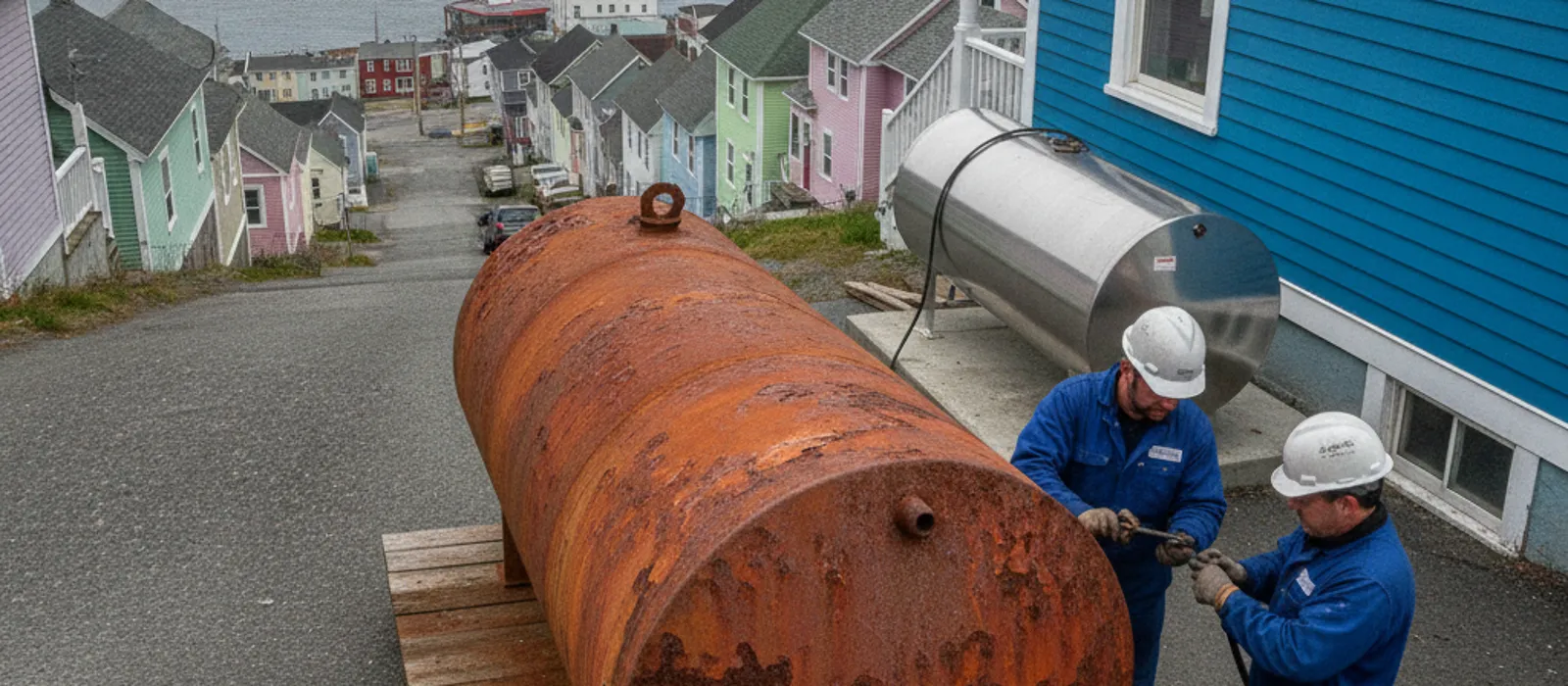
That orange streak down the side of the tank wasn’t there in the fall. Now the snow’s finally off the pad and you’re standing in the backyard in Paradise wondering whether you’re looking at a stain or a bill.
Here’s the honest answer. Rust on oil tank steel is sometimes nothing and sometimes the last warning you’ll get before a leak. The trick is telling the two apart, and most of the time you can do that in ten minutes with a rag and a flashlight.
This guide covers what each kind of rust means, how to check without making things worse, what your HOST tag says about it, and what replacing a rusty tank costs around St. John’s and the Avalon.
Why rust on an oil tank is a bigger deal on the Avalon
A residential heating oil tank is a mild-steel box holding around 900 litres of fuel, usually sitting on a stand a couple of feet off the ground. Steel and water don’t get along. Add salt air off the harbour, a winter of freeze and thaw, and drizzle that blows sideways for weeks, and the outside of that box is under attack from the day it’s installed.
The inside has it worse. Every time the tank sits half empty through a mild spell, moisture condenses on the cold steel above the oil line. That water sinks to the bottom because it’s heavier than oil, pools there, and eats the floor of the tank from the inside out. That’s why tanks almost always fail at the bottom, in the one spot you can’t see.
The province doesn’t leave this to guesswork. Under the Heating Oil Storage Tank System Regulations, 2003, every registered tank in Newfoundland and Labrador carries a HOST tag with an expiry date. That date is based on the tank’s steel gauge, outlet position and location, not on how it looks. A tank can be gleaming and still be illegal to fill, and a scruffy one can have years left. We’ll come back to that.
One thing before you go further. If the rust you found is wet, if there’s a bead of oil sitting in it, or if you can smell fuel near the tank, stop reading and call (709) 800-3117. That line’s answered 24 hours a day, and a weeping tank in a St. John’s winter isn’t something to sleep on.
The four kinds of rust you’ll see on a rusty oil tank
Not all rust is the same rust. Here’s what each type looks like and what it usually means.
1. Surface bloom. A light orange haze, or a few freckles where the paint’s been scratched by a shovel or worn by the fill hose. Wipe it with a rag and the metal underneath is smooth and solid. This is cosmetic. It’ll spread if you ignore it, but it isn’t hurting the tank today.
2. Run-off streaks. Rust-coloured drips running down from a fitting, the gauge, the vent, or the fill pipe. Nine times out of ten this is the fitting rusting, not the tank. It still deserves a look, because a weeping fitting can be leaking a little oil too.
3. Scale and flaking. Rust thick enough to lift off in layers, like the bottom of an old wheelbarrow. When it comes away under a fingernail, the steel underneath has lost thickness. This is where “stain” turns into “structural.” A 14-gauge tank wall is only about 2 millimetres thick to begin with, and it doesn’t have much to give.
4. Pitting and weeping. Small dark craters in the steel, sometimes with a damp ring around them, sometimes with a drop of oil sitting right in the pit. This is the tank corroding through. A weeping pit on the bottom is a leak that hasn’t found its way out yet, and it will.
The first two you can handle with a wire brush and a can of rust paint. Our post on painting an oil tank to slow rust covers how to do it properly. The last two mean the tank is on borrowed time, no matter what the tag says.
A ten-minute rust check you can do yourself
You don’t need tools for this. Grab a flashlight, a clean rag, and a flattened cardboard box.
Look at the legs and the pad first. Rust at the base of the legs means water’s been pooling there. Check the tank’s still sitting level. One that’s tilted away from the outlet keeps water at the far end with no way out.
Wipe the worst spot. Rub the rustiest patch with the rag. Smooth and the same colour as the rest of the tank means surface rust. Rough, flaky, or dotted with tiny dark spots means pitting.
Press, don’t poke. Push firmly on the rusty area with your thumb. Solid steel doesn’t move. If it flexes, dents, or crackles, stop right there and don’t reach for a screwdriver. People have put a hole in a weak tank floor trying to “test” it, and ended up with 600 litres of oil on the lawn.
Slide the cardboard under the tank. Leave it overnight and check it in the morning. Even a spot the size of a loonie means the tank or a fitting is weeping.
Sniff around the fittings. Fresh heating oil has a sharp, unmistakable smell. If you catch it near the bottom outlet, the filter, or the seam along the bottom, that’s your answer.
Read the tag. Write down the six-digit number and the expiry, stamped as month and year, something like 04-2027. You’ll want it for the next section.
Know when to stop. End the DIY check if you find wet rust, a drop of oil, flaking on the bottom half, or an expired tag. At that point you need a licensed inspector, not a second opinion from the neighbour.
Rust on the bottom of an oil tank: the failure you can’t see
Here’s the frustrating part. The rust you can see on the sides is usually the least of your problems. The steel that fails is the floor of the tank, and it fails from the inside.
Gerald in Torbay found that out last February. His outdoor tank looked fine from the driveway, a bit of orange around the fill cap and nothing else. Then the delivery driver ran a hand along the underside and found a soft patch the size of a dinner plate at the low end. The tag still had four months on it. The driver refused the fill anyway, because the regulations say a driver who spots a deficiency has to report it, and no company wants its name on a spill.
Gerald was down to a quarter tank in a cold snap. He got a written estimate the same day, and a 200-gallon painted steel tank went in for $3,200, old one hauled away in the price, before he ran dry. Not how anyone wants to spend February, but a lot cheaper than a cleanup.
What made his tank go early? An end-outlet design that left water and sludge sitting on the floor, plus two summers sitting near empty. That’s the perfect recipe for condensation.
Indoor tanks aren’t immune. Denise in Mount Pearl noticed a faint oil smell in her rec room in January. Her basement tank was 22 years old on a 25-year tag, so she assumed she had time. With a flashlight she found a damp rust ring around a pit on the underside and a stain on the concrete the size of a toonie. She called the emergency line, had the tank pumped down and disconnected, and had a Roth double-wall tank installed for $3,850 with the old one removed. Because she caught it as a drip and not a puddle, the floor cleanup was minor.
She also reported it to the province, which is the right move any time oil reaches the floor or the ground. The Pollution Prevention Division of Environment and Climate Change NL handles petroleum storage and environmental emergencies, and our post on what to do when an oil tank is leaking walks through the first hour.
What the HOST tag says about a rusty oil tank
Rust tells you how the tank’s doing. The tag tells you how long the province will let you use it. Those are two different questions, and you need answers to both.
Every registered tank system in NL carries a metal HOST tag with a six-digit number and an expiry stamped in MM-YYYY form. A tag reading “7-2028” means the tank can’t be used after July 31, 2028. That expiry comes from section 15 of the regulations, and it depends on the gauge of the steel, where the outlet is, and whether the tank is inside or outside.
For a plain single-wall steel tank, the maximum service life works out like this:
| Tank type | Outside | Inside a building with a foundation |
|---|---|---|
| 14-gauge, end or top outlet | 10 years | 15 years |
| 12-gauge, end or top outlet | 15 years | 20 years |
| 14-gauge, bottom outlet | 15 years | 20 years |
| 12-gauge, bottom outlet | 20 years | 25 years |
Fibreglass and double-wall tanks get a much longer life set by the administrator, capped at 50 years. Fibreglass tags have been seen stamped out to 2061.
Two things follow from that table. First, those numbers are maximums, not guarantees. A badly rusted tank with years left on the tag can still be failed by the inspector or refused by the driver, which is what happened to Gerald. Second, once the tag expires, looks don’t matter. Section 13 says heating oil can’t be delivered to a system without a valid registration label, and section 4 says you can’t operate one. The prettiest tank in Conception Bay South is a lawn ornament once the date passes.
If you’re not sure how to read yours, this guide to the HOST tag walks through it with photos. If the date’s already gone by, that’s an expired tank emergency, not a someday job. Call (709) 800-3117 and we’ll get an inspector-tagged replacement moving.
Paint it, patch it, or replace it: what each option costs
Marion in Kelligrews called about “rust all down one side” of a tank that was only eight years old. It turned out to be a run-off streak from an unpainted fill fitting, and the tank underneath was solid. She wire-brushed it, put on two coats of rust paint, had the fitting snugged up, and spent a Saturday afternoon instead of a few thousand dollars. She asked for a written estimate on a fibreglass upgrade anyway, $3,850 installed, so she’d have the number in hand when the time comes.
That’s the right instinct. Here’s how the options line up.
| What you found | What it means | What to do | Cost (CAD) |
|---|---|---|---|
| Light surface rust, solid steel underneath | Cosmetic, the paint’s failed | Wire brush and rust paint | A can of paint and an afternoon |
| Streaks from a fitting, no oil | The fitting is corroding | Clean it, tighten or replace the fitting, paint | Small repair, quoted case by case |
| Flaking or scale on the sides, years left on the tag | Steel is thinning | Get an inspector’s opinion, start budgeting | Free written estimate |
| Flaking, pitting or wet rust on the bottom | Failing from the inside | Replace before it leaks | $3,200 steel, $3,850 fibreglass or Roth, installed |
| Tag expired, any condition | Illegal to fill or use | Replace now | Same as above; after-hours premium varies by contractor |
| Old tank out, switching to a heat pump | Removal only | Empty, remove, dispose, restore the site | $500 outdoor; indoor quoted case by case |
Two notes on that table. Patching a rusty steel shell with epoxy or a welded plate isn’t a fix we’d put our name to, and it’s not one you should expect an inspector to tag. If the steel’s gone, the tank’s gone.
Those installed prices include removing and disposing of the old tank, and that matters. Section 16 of the regulations gives you 30 days after disconnecting a tank to have it emptied, cleaned of sludge, dismantled and gone. After a leak, that drops to 10 days. Doing the swap in one visit keeps you clear of both deadlines.
If you’re weighing steel against fibreglass, the short version is that fibreglass costs $650 more, can’t rust, and gets a tag that will outlast most mortgages. Details are on our fibreglass upgrade page. For a like-for-like swap, the oil tank replacement page covers what’s included and how the day goes.
Whatever you found on your tank, a free written estimate costs you nothing but a few photos. Send them through the contact form with your tag number and expiry, and we’ll tell you straight whether you’re looking at a paint job or a replacement.
Frequently Asked Questions
Can I just paint over rust on my oil tank?
Yes, if it’s surface rust with solid steel underneath. Wire-brush the loose rust off, wipe the area clean, and apply a rust-inhibiting metal paint in two thin coats. Don’t paint over flaking, pitting, or anything damp, because paint hides the problem without fixing it, and the inspector will want to see bare metal anyway.
Will a delivery driver refuse to fill a rusty oil tank?
They can, and on the Avalon they do. Under the provincial regulations a driver who spots a deficiency has to report it, and a soft or weeping tank counts. An expired HOST tag is an automatic refusal no matter how the tank looks. If you’ve been refused, call the 24/7 line and treat it as urgent, because there’s no second delivery coming until the tank is replaced and tagged.
Does rust mean my oil tank is leaking?
Not by itself. Surface rust and streaks from fittings are common on tanks with years of safe life left. What signals a leak is wet rust, a drop of oil in a pit, a stain on the pad or floor, or a fresh fuel smell near the bottom of the tank. If you see any of those, stop testing it yourself and get a licensed inspector to look at it.
Is a fibreglass tank worth the extra money if rust is the problem?
For most homes in St. John’s, yes. A fibreglass tank runs $3,850 installed versus $3,200 for painted steel, and it can’t rust from the salt air outside or from condensation inside. It also gets a much longer HOST tag, so you’re not repeating this whole exercise in 10 to 15 years. If you plan to stay in the house, the extra $650 usually pays for itself in one avoided replacement.